13.05.2026
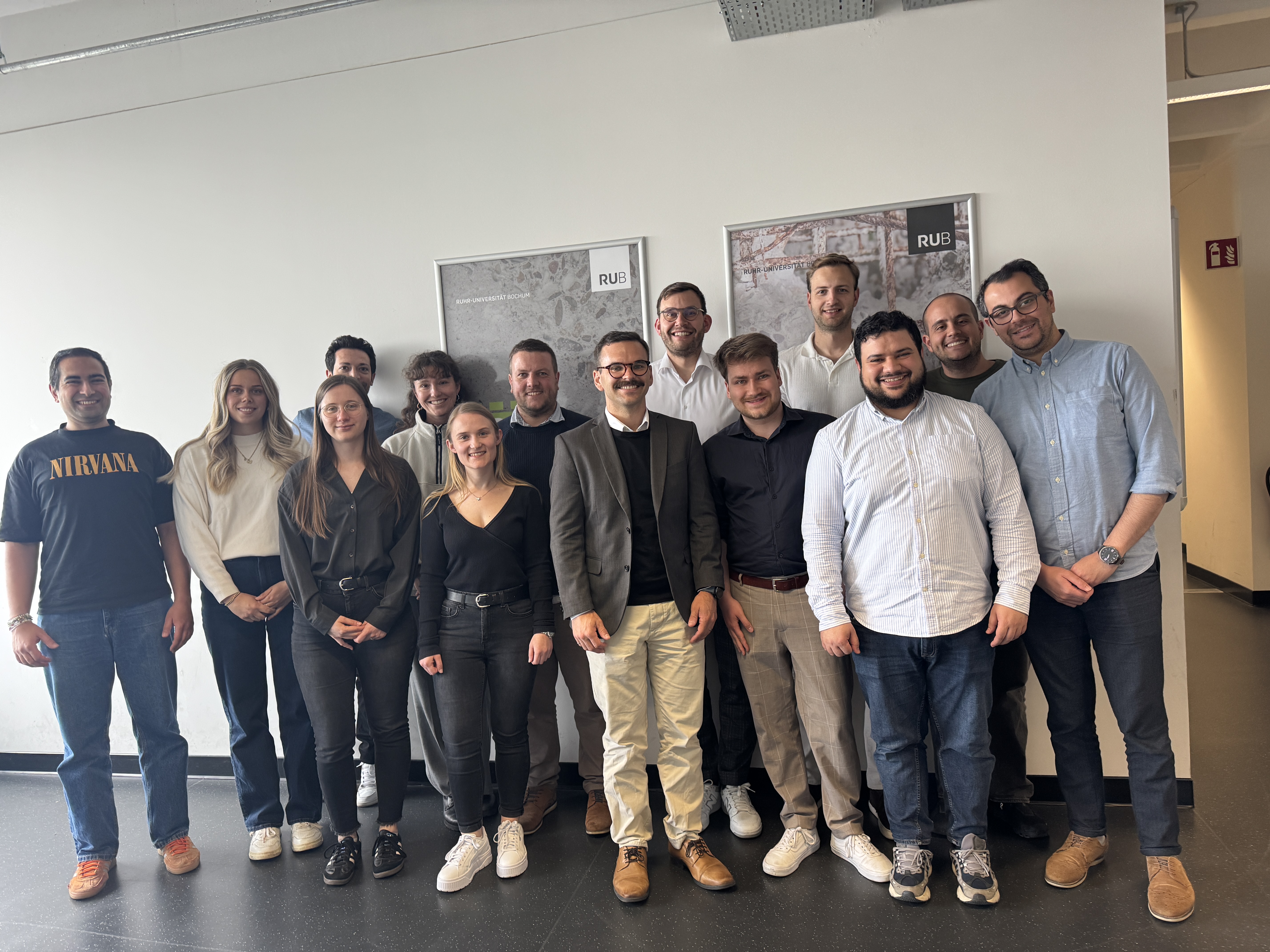
On May 13, Ruhr University Bochum hosted a scientific workshop on the reuse of concrete elements as part of Collaborative Research Centre (CRC) 1683.
The event aimed to bring together different perspectives and discuss how industrialized processes and circular approaches can be combined to advance more sustainable solutions in concrete construction.
The workshop opened with a keynote presentation by Prof. Christopher Rausch (The University of Texas at Austin, USA), who provided insights into the intersection of industrialization and the circular economy. His presentation focused on end-of-life management strategies for buildings in the United States, particularly in Austin, Texas, where increasing supply-chain costs are driving the adoption of deconstruction and material reuse practices.
These concepts were illustrated through two case studies. The first examined the deconstruction of the Frank Erwin Center basketball arena, where conventional demolition by explosives was not feasible due to the proximity of critical infrastructure. The second highlighted examples of smaller and medium-sized buildings in Austin, where windows, doors, and timber components were carefully preserved for reuse as part of broader sustainability efforts. The keynote also addressed the future potential of robotic deconstruction technologies and design for circularity as promising approaches for the construction industry.
The workshop continued with an introduction to CRC 1683, followed by presentations from Philipp Hagedorn, Franziska Günther, Anna-Lena Schürmann, Yehia Abdelazziz, and Nina Krautgartner. Their contributions provided an overview of current research activities and addressed topics including life cycle assessment, data collection, transport and logistics, and process simulation.
The event concluded with a guided tour of KIBKON, offering participants additional insights into the research infrastructure and ongoing activities at the site.
Overall, the workshop provided a valuable platform for scientific exchange and interdisciplinary networking. Discussions focused on the potential of digital methods, sustainability assessment, and circular strategies to shape the future of concrete construction. We would like to thank Prof. Christopher Rausch for his keynote presentation and all speakers for their valuable contributions. We look forward to continued collaboration and future exchanges.
On May 13, Ruhr University Bochum hosted a scientific workshop on the reuse of concrete elements as part of Collaborative Research Centre (CRC) 1683.
The event aimed to bring together different perspectives and discuss how industrialized processes and circular approaches can be combined to advance more sustainable solutions in concrete construction.
The workshop opened with a keynote presentation by Prof. Christopher Rausch (The University of Texas at Austin, USA), who provided insights into the intersection of industrialization and the circular economy. His presentation focused on end-of-life management strategies for buildings in the United States, particularly in Austin, Texas, where increasing supply-chain costs are driving the adoption of deconstruction and material reuse practices.
These concepts were illustrated through two case studies. The first examined the deconstruction of the Frank Erwin Center basketball arena, where conventional demolition by explosives was not feasible due to the proximity of critical infrastructure. The second highlighted examples of smaller and medium-sized buildings in Austin, where windows, doors, and timber components were carefully preserved for reuse as part of broader sustainability efforts. The keynote also addressed the future potential of robotic deconstruction technologies and design for circularity as promising approaches for the construction industry.
The workshop continued with an introduction to CRC 1683, followed by presentations from Philipp Hagedorn, Franziska Günther, Anna-Lena Schürmann, Yehia Abdelazziz, and Nina Krautgartner. Their contributions provided an overview of current research activities and addressed topics including life cycle assessment, data collection, transport and logistics, and process simulation.
The event concluded with a guided tour of KIBKON, offering participants additional insights into the research infrastructure and ongoing activities at the site.
Overall, the workshop provided a valuable platform for scientific exchange and interdisciplinary networking. Discussions focused on the potential of digital methods, sustainability assessment, and circular strategies to shape the future of concrete construction. We would like to thank Prof. Christopher Rausch for his keynote presentation and all speakers for their valuable contributions. We look forward to continued collaboration and future exchanges.
Copyright © SFB1683 2026
Last update: Jun 16, 2026