04.08.2026
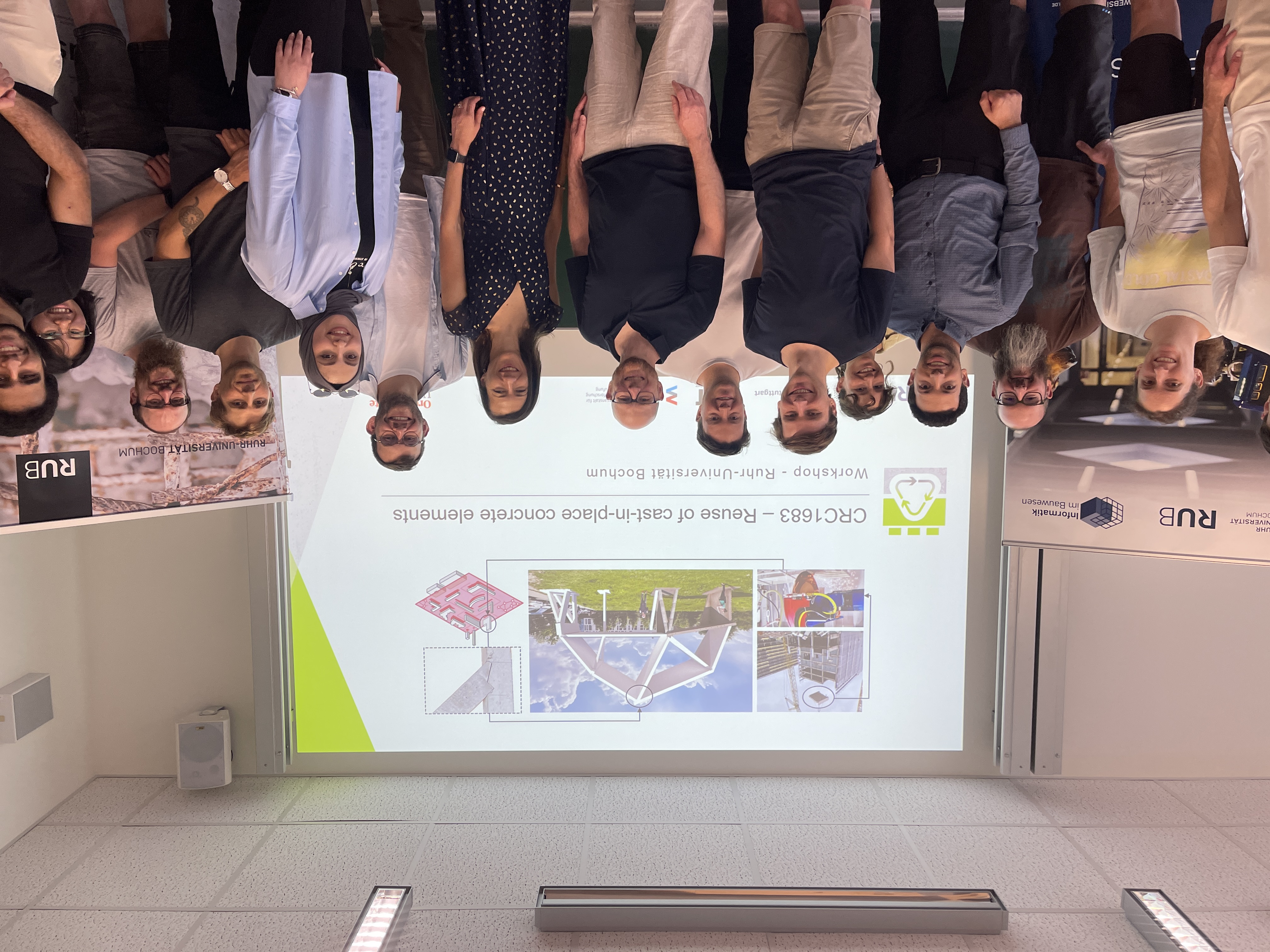
On July 30, 2026, the workshop “AI for Sustainable Construction” took place at the RUB and online as part of CRC 1683.
We were joined by Dr. Yelda Turkan, currently an associate professor in the Department of Civil Engineering at Oregon State University. She opened the workshop with a thought-provoking keynote address and a presentation of her work. Dr. Turkan’s research focuses on applications in the fields of computer vision and machine learning for a sustainable and resilient built environment. She uses technologies such as LiDAR and digital twins to optimize the planning, monitoring, and control of construction projects and to improve decision-making in the built environment.
Dr. Philipp Hagedorn then introduced the research agenda of CRC 1683, which views the modular reuse of building components as a key lever for resource-efficient construction. Prof. Dr. Merita Tafili (online) set the first technical focus with an in-depth look: She demonstrated how AI can reveal the untapped potential of existing foundations and thus promote geotechnical sustainability.
After a lunch break that included a campus tour, the program continued with a session on robot-assisted structural diagnostics. Patrick Herbers presented AI-based methods for locating damage in concrete structures, before Youssef Aknin introduced the next generation of humanoid inspection robots. Following the coffee break, Dr. Phillip Schönfelder demonstrated how AI extracts precise digital geometries of existing buildings from analog drawings, a crucial step for reuse in existing buildings. To conclude, a VR Lab tour offered a glimpse into immersive tools that could transform planning, analysis, and training in the construction industry in the future.
On July 30, 2026, the workshop “AI for Sustainable Construction” took place at the RUB and online as part of CRC 1683.
We were joined by Dr. Yelda Turkan, currently an associate professor in the Department of Civil Engineering at Oregon State University. She opened the workshop with a thought-provoking keynote address and a presentation of her work. Dr. Turkan’s research focuses on applications in the fields of computer vision and machine learning for a sustainable and resilient built environment. She uses technologies such as LiDAR and digital twins to optimize the planning, monitoring, and control of construction projects and to improve decision-making in the built environment.
Dr. Philipp Hagedorn then introduced the research agenda of CRC 1683, which views the modular reuse of building components as a key lever for resource-efficient construction. Prof. Dr. Merita Tafili (online) set the first technical focus with an in-depth look: She demonstrated how AI can reveal the untapped potential of existing foundations and thus promote geotechnical sustainability.
After a lunch break that included a campus tour, the program continued with a session on robot-assisted structural diagnostics. Patrick Herbers presented AI-based methods for locating damage in concrete structures, before Youssef Aknin introduced the next generation of humanoid inspection robots. Following the coffee break, Dr. Phillip Schönfelder demonstrated how AI extracts precise digital geometries of existing buildings from analog drawings, a crucial step for reuse in existing buildings. To conclude, a VR Lab tour offered a glimpse into immersive tools that could transform planning, analysis, and training in the construction industry in the future.
Copyright © SFB1683 2026
Last update: Aug 04, 2026